
TL;DR
A slow, uneventful first week works better for an adopted adult dog than a warm welcoming party. Expect some hiding, clinginess, or a skipped meal in the first 24 to 48 hours, and treat it as normal. Keep the routine boring and predictable: same feeding times, same walk, same sleeping spot, every single day. Hold off on vet visits, grooming, and dog parks until day four or five unless something looks urgent. Real settling in tends to take closer to three weeks than three days, so judge slowly.
Most people picture the first hour home with an adopted dog as the good part: tail wagging, exploring every room, curling up on the sofa by evening. For adult dogs coming out of a shelter, the more common scene is a dog who will not eat, will not make eye contact, and disappears under the nearest piece of furniture. That reaction unsettles a lot of new owners into thinking they made a mistake. It usually means the opposite: the dog is decompressing exactly on schedule, and here is what that schedule actually looks like.
The 3-3-3 rule undersells adult dogs, in both directions
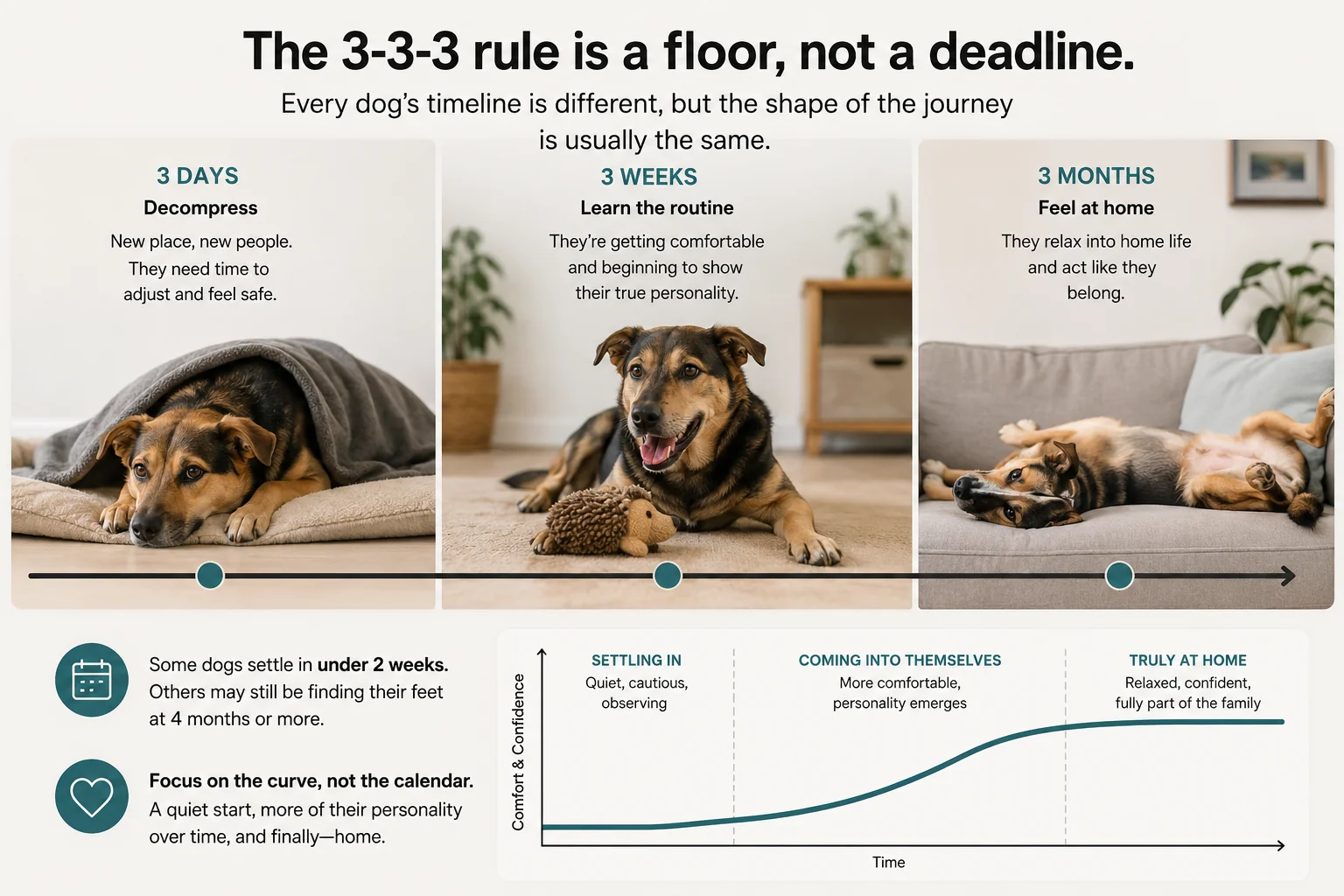
Many shelters and rescues hand new adopters a rough timeline known as the 3-3-3 rule: three days to decompress, three weeks to learn the household routine, three months to feel fully at home. It is a useful mental model, but adult dogs do not follow it as neatly as the framework suggests. A dog with a stable prior home who was surrendered because of a landlord's no-pets policy might settle in under two weeks. A dog who spent months cycling through a shelter with little consistent handling might still be finding his feet at month four. Treat the 3-3-3 rule as a floor, not a deadline.
What does not vary as much is the shape of the curve. There is almost always a flat, quiet opening stretch, followed by a personality that gradually becomes more visible, followed by a dog who finally acts like he lives there instead of like he is visiting. Expecting that shape, rather than a fixed number of days, makes the slow start easier to sit through.
What is actually happening in the first 48 hours
Shelter life is loud, unpredictable, and physically stressful, and that does not switch off the moment a dog walks through your front door. Veterinary behaviourists who study shelter-to-home transitions generally find that stress hormones stay measurably elevated for several days after a dog leaves a shelter environment, even once the immediate stressor is gone. A dog who will not eat on day one, paces at night, or startles at ordinary household sounds like a dishwasher or a closing door is not reacting to your home specifically. He is still running on a nervous system that has not caught up with the fact that things have changed.
This is exactly why an eventless first two days matters more than an exciting one. Skip the introductions to the neighbours, the trip to the pet store to pick out toys together, the excited phone calls where everyone wants to meet him. Give him a single room to start in, a water bowl, a bed, and permission to ignore you for a while if that is what he needs.
Building a boring, repeatable schedule from day one
Structure calms an unsettled dog faster than affection does, at least at first. Feed at the same two times every day. Walk the same short, low-traffic route rather than varying the scenery to keep things interesting. Put the bed or crate in the same spot and leave it there. None of this needs to be elaborate: the value is in the repetition, which gives an anxious dog something predictable to hold onto while everything else about his life has just changed.
If there are other pets already in the house, the pace matters even more. Rushing a first meeting between a newly adopted dog and a resident cat or dog is one of the more common ways an otherwise good match gets off to a rocky start. Our step-by-step guide to introducing a dog and a cat covers a slower, safer sequence if that applies to your household.
Reading the early signals instead of guessing
A dog who skips a meal or two in the first 48 hours is common and rarely a medical problem on its own; most start eating normally again within a couple of days once stress hormones settle. What is worth watching more closely is body language: a tucked tail, flattened ears, repeated yawning or lip-licking when nothing obvious is happening, and a dog who freezes rather than moves. These are stress signals, not disobedience, and the right response is to lower the pressure, not add more stimulation to try to cheer him up.
If a dog refuses food entirely past 48 to 72 hours, seems lethargic beyond simple withdrawal, or shows signs like vomiting or diarrhoea, that is a reason to call a vet rather than wait it out. Adjustment stress and illness can look similar early on, and it is worth ruling out the second one.
Why an uneventful week three usually beats an exciting week one
The households that report the smoothest first month are, almost without exception, the ones that resisted the urge to make the first week special. No big backyard gathering to introduce the new dog to everyone, no long weekend trip to bond, no rearranging the whole house before he has even had a chance to learn where the water bowl lives. A dog who spends his first ten days in a calm, predictable environment tends to reach the relaxed, food-motivated, tail-wagging version of himself faster than one who was flooded with new experiences on day one.
It is worth being honest with anyone eager to meet the new arrival: visitors, however well-meaning, are a variable your dog does not need yet. Most of the mistakes that derail an otherwise good adoption match happen in exactly this window, and our guide to the most common mistakes after adopting a pet walks through the specific ones worth avoiding here.
Planning past the first month
Once the first few weeks settle down, ongoing costs become the more relevant planning question, since routine vet care, food, and gear are recurring rather than one-off. If you have not already worked out roughly what a dog costs to keep month to month, our breakdown of what a dog really costs each month is a useful next read once the adjustment period is behind you.
By week three or four, most adopted adult dogs have shifted from a guest observing a new environment to a resident who has opinions about it. That shift, more than any specific day on a calendar, is the real marker that the slow start worked.
Key takeaways
Expect a flat, quiet start rather than an immediate bond, and judge progress over three weeks, not three days. Keep the first 48 hours low-stimulation: one room, a fixed routine, no visitors. Watch body language, not just appetite, for signs of stress. Call a vet if a dog will not eat past 48 to 72 hours or shows other symptoms. A boring, repeatable schedule settles a new dog faster than an exciting one does.
If you are still in the adjustment window and want more of this kind of week-by-week practical guidance for new adopters, our newsletter covers exactly that, alongside the rest of what we publish.
Frequently asked questions
How long does it really take for an adopted adult dog to settle in?
Most dogs need about three weeks to learn the household routine and closer to three months to feel fully at home, though a dog with a stable prior history can settle faster. Judge progress in weeks, not days.
Is it normal for a newly adopted dog to refuse food at first?
Yes, skipping a meal or two in the first 48 hours is common and usually resolves on its own as stress hormones settle. If a dog refuses food past 72 hours, contact your vet to rule out an underlying issue.
Should I introduce my new dog to friends and family right away?
It is better to wait at least a week or two. Extra visitors add stimulation a decompressing dog does not need yet, and most early mismatches trace back to an overly eventful first few days.
What if my adopted dog will not stop following me around the house?
Mild shadowing in the first weeks is normal and usually fades as the dog builds confidence in the new environment. Give him a comfortable spot of his own nearby rather than shutting the behaviour down.
When should I schedule the first vet visit after adopting an adult dog?
Within the first week is reasonable for a general check-up, unless the shelter paperwork shows a recent exam. Avoid booking it for day one or two if possible, since a car ride and a clinic add stress on top of an already big transition.